Index evidence
Normalize objects, room cues, relations, optional 2D/3D boxes, and supporting views.
Graph-pruned semantic search
A hierarchical semantic graph that prunes scene search before grounding natural-language queries in captured evidence.
Research prototype. Current claims are deterministic, test-backed, and scoped below.
Research question
SemanticSplat organizes the same semantic records used by flat search into scene, zone, region, object, and view-evidence levels. A query retains likely branches, ranks their leaves, and expands only when confidence or geometry requires fallback.
Hierarchy substantially reduces checked views and serialized query context. The present lexical ranker does not yet preserve flat-search hit@k on the internal track, so the evidence supports a measured quality-cost tradeoff, not universal superiority.
Method
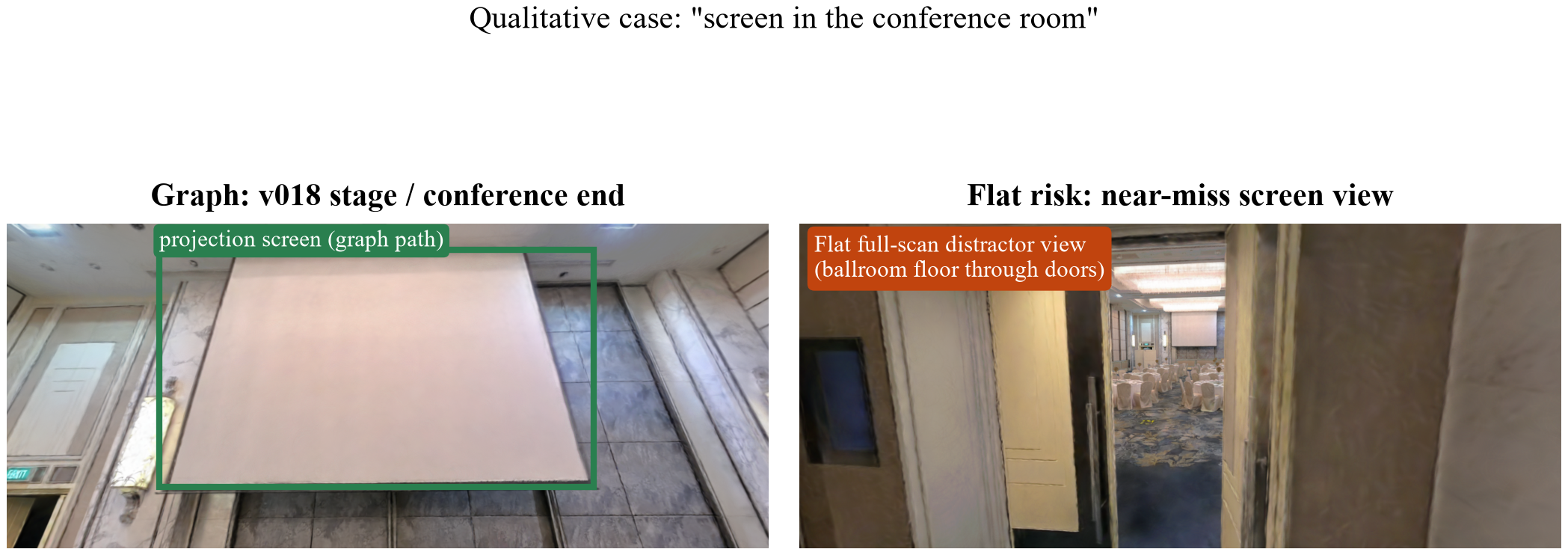
The figure is assembled from the real Conference Hall RGB-D capture, its ViewJSON record, the checked-in hierarchy, and frozen query qv2_010. No AI-generated imagery is used.
Normalize objects, room cues, relations, optional 2D/3D boxes, and supporting views.
Attach deterministic entity records beneath scene, zone, and region branches.
Extract target, attributes, intent, optional anchor, and spatial relation.
Gate branches, score retained entities, validate geometry, and expand on low confidence.
Evidence
Internal graph-versus-flat numbers are directly comparable. Public-dataset and external-baseline tracks answer different questions and are not collapsed into a single ranking.
Graph reduces mean views by 75.5% and estimated context tokens by 68.2%. On 125 queries with verified view labels, hit@1 is 0.680 graph versus 0.768 flat; hit@3 is 0.808 versus 0.928.
Inspect the frozen metrics JSON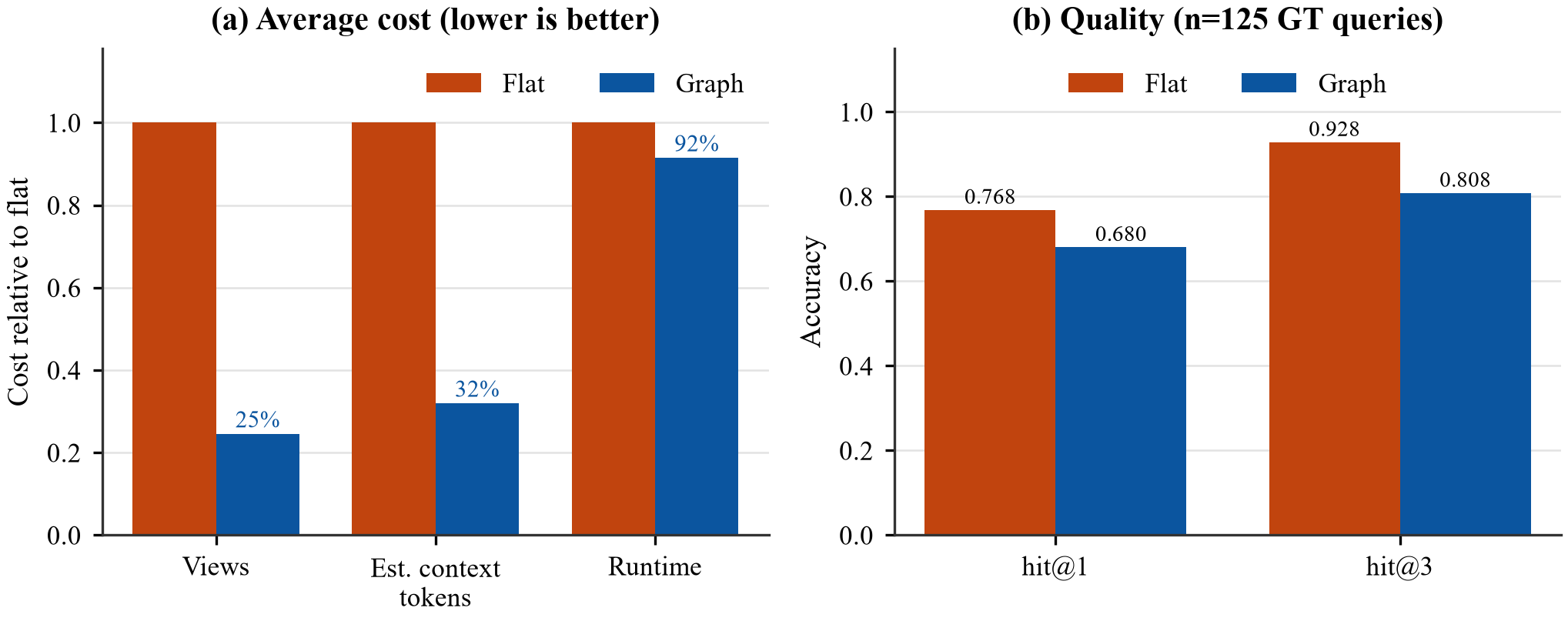
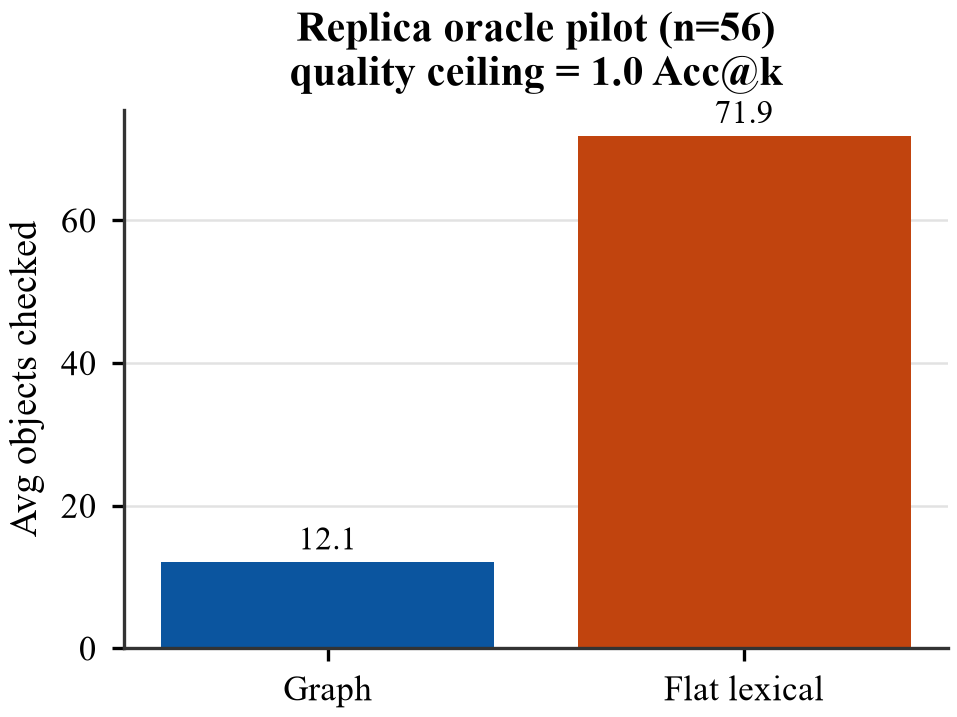
Replica: 8 scenes, 575 official GT boxes, 56 queries. ScanNet: 8 scenes, 392 official GT boxes, 48 Nr3D/Sr3D+ queries. These runs evaluate retrieval over official semantic maps, not predicted semantic perception.
Open canonical outputs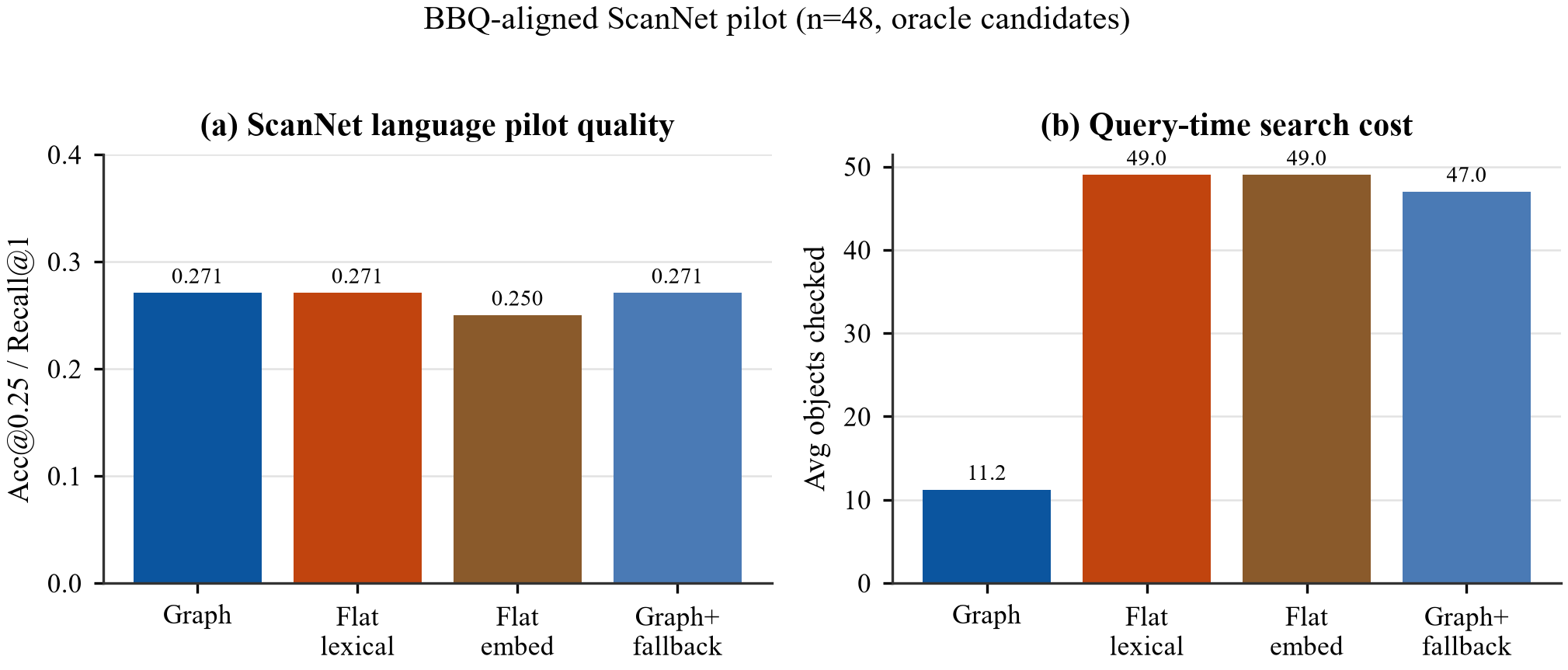
| Execution | Scope | Measured status | Comparison boundary |
|---|---|---|---|
| ConceptGraphs / ScanNet | 8 scenes, 48 queries | Native predicted-map run complete | Different map construction and query protocol |
| ConceptGraphs / Replica | 8 scenes, 56 queries | Native predicted-map run complete | Different map construction and query protocol |
| LangSplat / ScanNet | 1 scene, 6 queries | Full native pipeline complete | Hardware-adapted 3,000-iteration profile; not an 8-scene paper-scale reproduction |
These executions establish integration and diagnostic reference points. They do not establish a fair method ranking against SemanticSplat.
Construction accounting
The frozen audit separates one-time map preparation from per-query retrieval. It records the complete annotation payload, deterministic tree representation, serialized I/O, and clean-rebuild runtime for all five captured scenes.
Download construction auditData
The page publishes scene IDs, manifests, derived metrics, and reproduction code. Licensed ScanNet and Replica scene files are not mirrored.
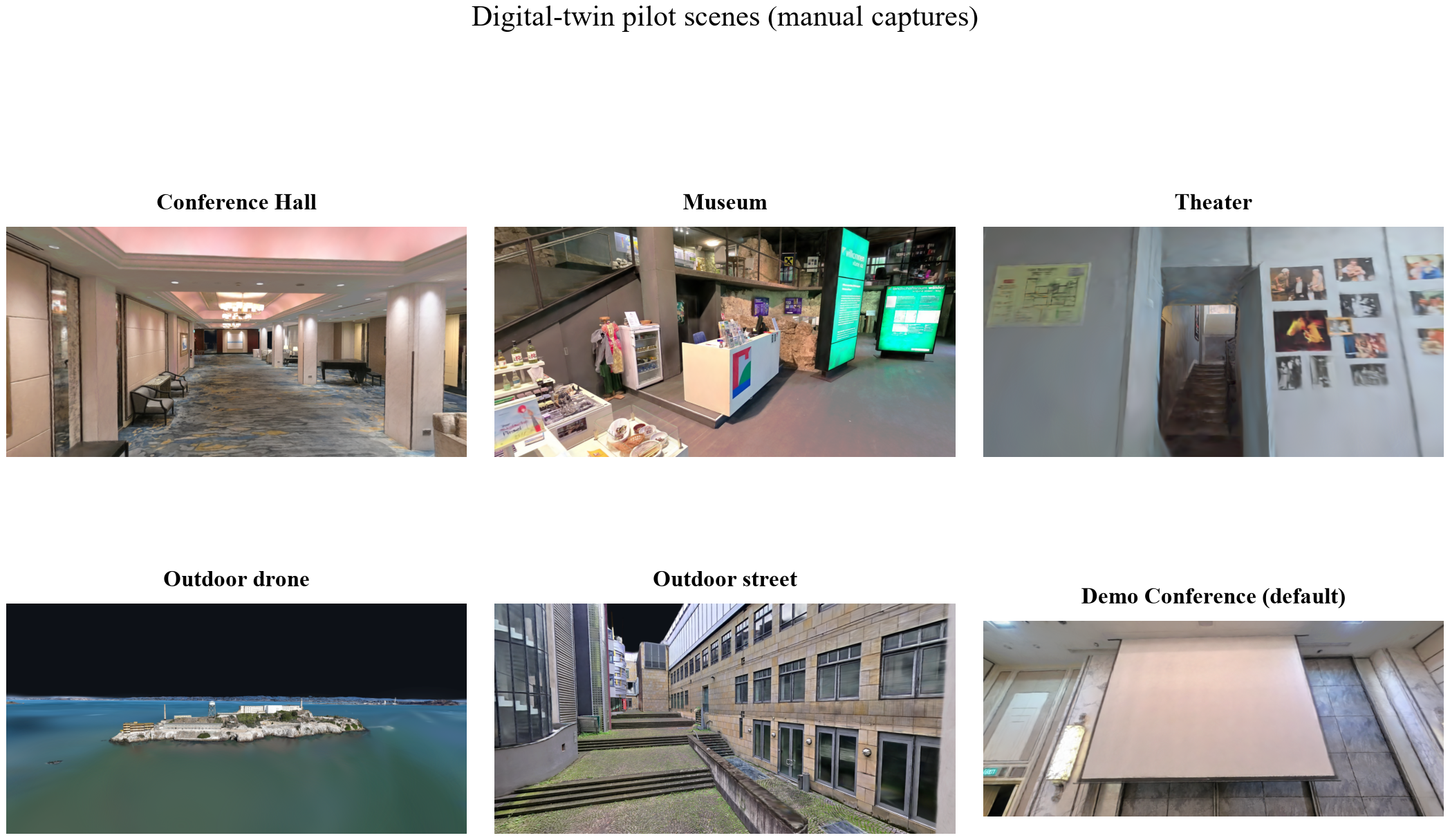
ConferenceHall-capture-pilot, Museume-capture, Theater-capture, outdoor-street-capture, and outdoor-drone-capture.
scene0011_00, scene0030_00, scene0046_00, scene0086_00, scene0222_00, scene0378_00, scene0389_00, scene0435_00.
room0-room2 and office0-office4, aligned with the BBQ subset used in the paper.
Machine-readable scene lists and access notes: dataset manifest JSON.
Visual audit
Reproduce
python -B -m pytest -q
python -B scripts/check_academic_paper.py
python -B scripts/measure_graph_construction.py --repeats 7
python -B scripts/export_academic_figures.pyLimits
Manuscript
The public manuscript is a named-author academic preprint, independent of any workshop template. It includes the complete method, schemas, frozen metrics, uncertainty intervals, public-dataset pilots, external executions, and reproducibility contract.
@article{mousatat2026semanticsplat,
  title = {SemanticSplat: Graph-Pruned Semantic Search},
  author = {Mousatat, Mahmoud and Vizan, Leo and
            Shankin, Nikita and Nuruzov, Telman and
            Medvedev, Alexandr},
  year = {2026},
  note = {Preprint}
}